COLORED PENCIL Magazine Resources for Colored Pencil Artists
An artist’s eye I’ve always loved walking and I’m fortunate enough to have lived for the last 24 years in a place full of walking trails where the scenery is breath-taking. Yet I couldn’t see how to translate that dramatic coastline, those plunging cliffs and the vast expanse of silvery blue Mediterranean into artwork: it seemed too large a canvas for the detail and precision of my beloved colour pencils. Then one day I turned away from the sweeping vista and my attention was caught by the play of light on the wall of the Sanctuary behind me. I took many photos that day, just with my phone, and then at home I played around with the composition, choosing my favourite windows and adjusting the shadows. The sanctuary has been uninhabited for years and I wanted to convey that sense of emptiness while at the same time you expect to see a face at the window upstairs or the curtains to twitch downstairs. At last, I had discovered how to portray the soul of this beautiful region and walking its paths would never be the same.
When I drew “Al Santuario” our movements were already restricted by the pandemic, but then we went into full lockdown, which here on the west coast of Italy meant that we were not allowed to stray more than 200 meters from our home. That’s when I discovered hidden gems in the hills behind my house, taking photos along the way of peeling doors, overgrown walls, stairs and shadows, glimpses of sparkling sea and crumbling buildings. That’s when I discovered that a thing doesn’t have to be beautiful to be a good subject, it just needs to be interesting. This abandoned house really caught my imagination and the colours, textures and shapes were more inspirational than the finest palace. In my drawing I then used artistic license to replace a lowly milk bottle with a precious looking green vase, contrasting in colour and completely out of place with its surroundings. The idea of something precious being left behind in such a forgotten place really intrigued me. What was the story here? Who were the owners of the vase? What had happened to them?
“I discovered that a thing doesn’t have to be beautiful to be a good subject, it just needs to be interesting.
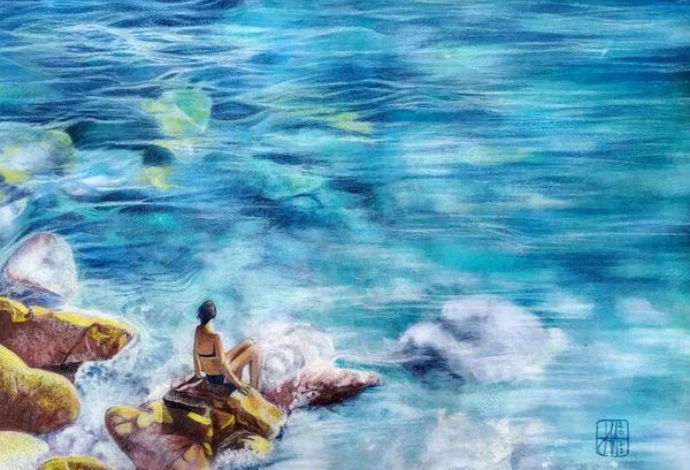
Lockdown lifted and we could go a little further, meaning I could return to the beach I’ve been going to since I came here in ’98, still local but not quite near enough for the strict Covid rules. Now I understood that I had to select details carefully, in fact I went there expecting to photograph scenes of the village, the black and white striped church with its odd skull and crossbones, the dappled light in the cobbled lanes, the bougainvillea draped over a stone wall. Instead, I was drawn to the colours of an October sea, to the shimmering turquoise of Monterosso that I have known so well both from the paths above looking down upon it and immersed in it, and I had to attempt a task that I felt I may now be ready for. Many photos later I had my perfect composition, the sea was choppy enough to be interesting and the figure added to the composition and the intrigue: what was she thinking? Why was she alone? I put down pan pastels first and actually loved the looseness of them so decided to keep my pencil work quite loose too. The important thing here was the colour; the movement and the light; the sense of the surf breaking; the October colours of the waves like precious stones; the golden light on the rocks and the lone figure, relaxed, yet poised, on the cusp between the two worlds.
“I seem to have found my niche somewhere in between, and somewhere close to home, portraying the atmosphere, the colours and the personality of the place I’ve chosen to call home, but that doesn’t mean I’ll stop trying new things.”